
AI Retrieval for Generative AI

Build scalable RAG and AI retrieval applications with accurate, low-latency retrieval.

Why RAG is Difficult to Scale

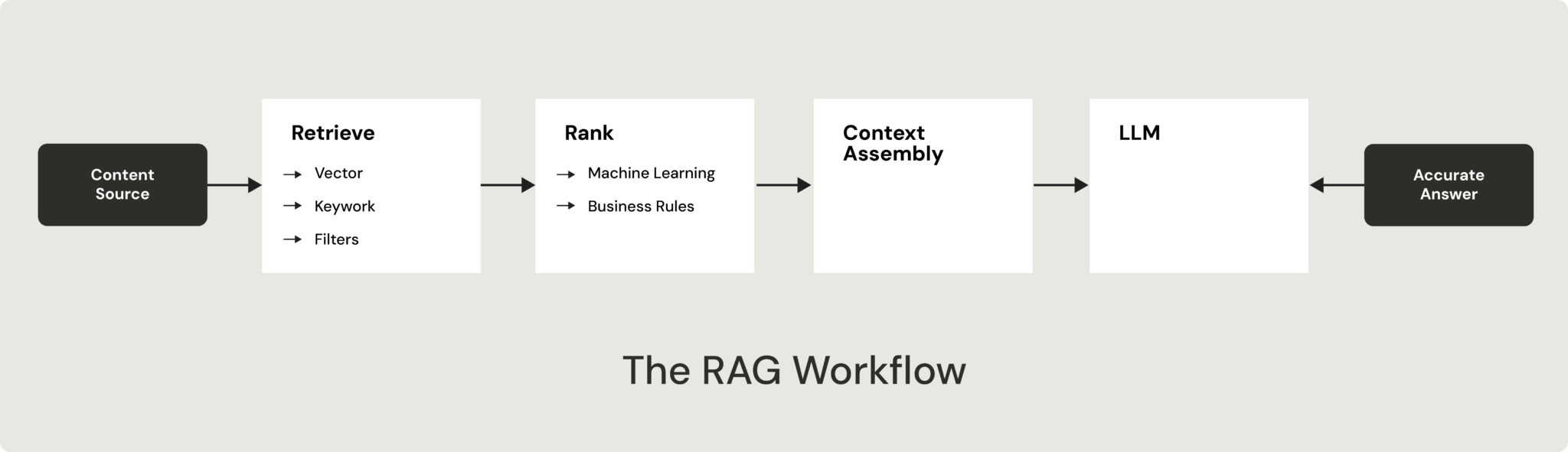
Retrieval-Augmented Generation (RAG) is the standard for grounding large language models with external knowledge. Early RAG applications combined embeddings, a vector database, and an LLM. As these applications mature, however, the retrieval workflow becomes significantly more sophisticated.

Improving answer quality often means adding hybrid retrieval, structured filtering, reranking, business rules, real-time updates, and machine learning inference. What begins as a simple RAG application gradually becomes a complex retrieval workflow spanning multiple specialized systems, increasing infrastructure cost, latency, and operational complexity. The rise of agentic AI compounds this problem, dramatically increasing retrieval volume while placing even greater demands on latency, freshness, and ranking quality.

Where retrieval workflows power customer-facing AI applications, every retrieval decision directly affects answer quality, response time, and user trust. Unlike traditional search, where users can compensate for imperfect ranking by selecting a better result, the language model can only answer using the context it receives.

Why the Retrieval Workflow Matters

As retrieval workflows become more sophisticated, optimizing the workflow becomes the primary engineering challenge. Teams are forced to balance answer quality against latency, infrastructure cost, and operational complexity. Those engineering compromises ultimately become compromises in the user experience, determining the quality of the AI application itself.

RAG is one application of AI retrieval. The real engineering challenge is building and optimizing the retrieval workflow that assembles accurate context before it reaches the language model.

Vespa is the AI Search Platform built for large-scale AI retrieval, not just RAG. Instead of stitching together vector databases, search engines, rerankers, and inference services, Vespa brings retrieval, ranking, and machine learning together in a single distributed serving engine.

Choose Vespa When:

  • AI answers directly affect customer experience and trust.
  • Retrieval quality determines application quality.
  • Vector search is no longer enough to build accurate context.
  • Ranking has become as important as retrieval.
  • Fresh data is essential for trustworthy responses.
  • Scale is exposing the limits of your retrieval architecture.
  • Agentic AI is dramatically increasing retrieval traffic.

Optimized Retrieval Pipeline

High-quality AI retrieval requires multiple retrieval and ranking stages, but adding more components often increases latency, infrastructure cost, and operational complexity.

Vespa is designed to optimize the entire retrieval pipeline. Instead of applying expensive ranking models to every candidate, Vespa uses multi-phase ranking to progressively refine results. Fast retrieval techniques identify promising candidates, while increasingly sophisticated ranking models—including machine learning inference—are applied only where they improve the final outcome.

Because retrieval, ranking, and machine learning execute within a single distributed serving engine, Vespa minimizes unnecessary data movement while maintaining high throughput and predictable latency. The result is more accurate context for large language models, enabling AI applications to deliver better answers without sacrificing performance at scale.

Independent analysis from GigaOm highlights how integrated AI Search Platforms reduce infrastructure complexity, improve performance, and lower operational costs compared with fragmented retrieval architectures.

One Engine

Optimize the entire retrieval pipeline.

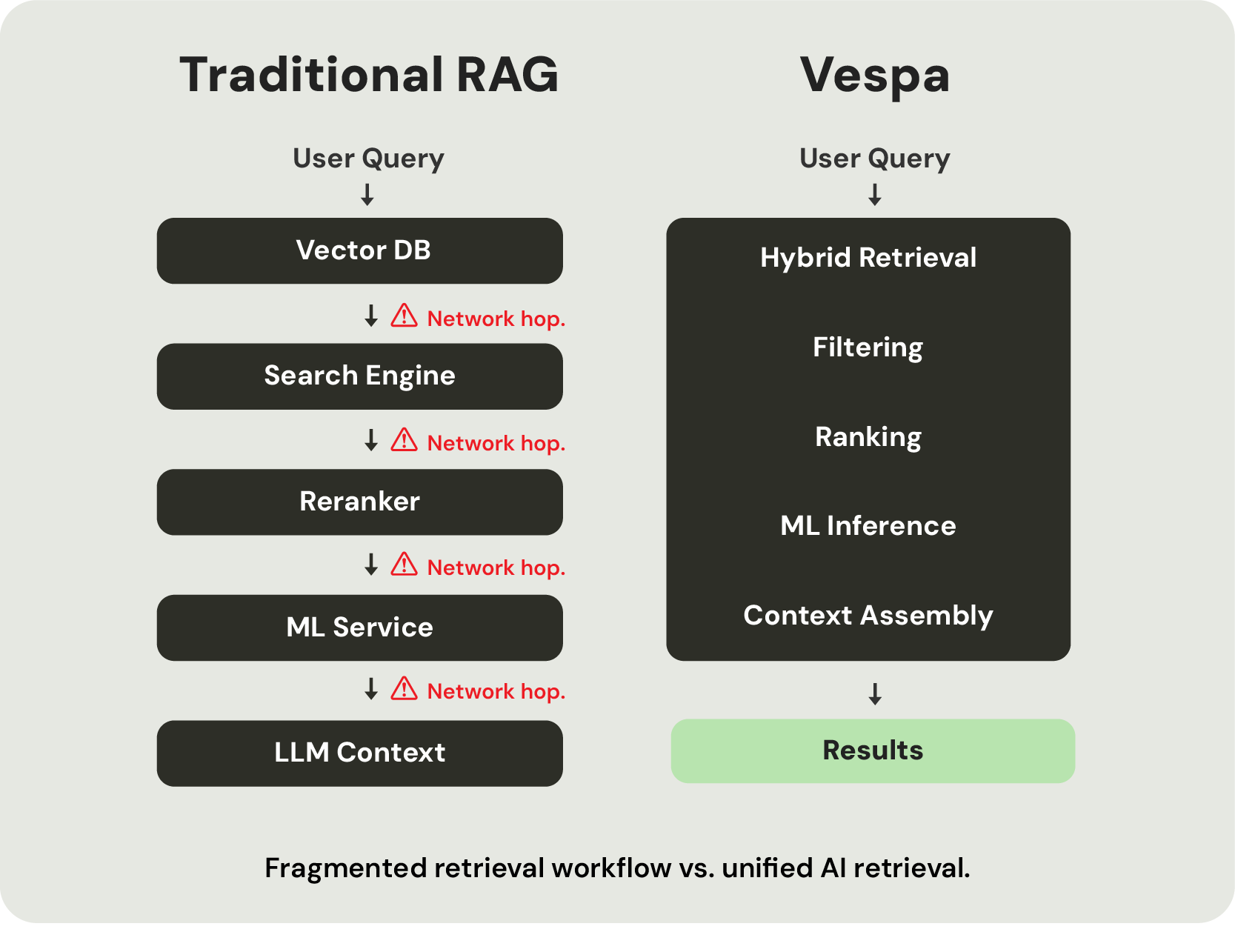
Many RAG architectures move data between vector databases, search engines, rerankers, and inference services before building context for the language model. Every additional service adds latency, cost, and operational complexity. Vespa performs retrieval, filtering, ranking, and machine-learning inference in a single distributed serving engine, delivering more accurate context with fewer moving parts and <100 ms latency required for large-scale AI retrieval.

Always Fresh

Better answers start with current information.

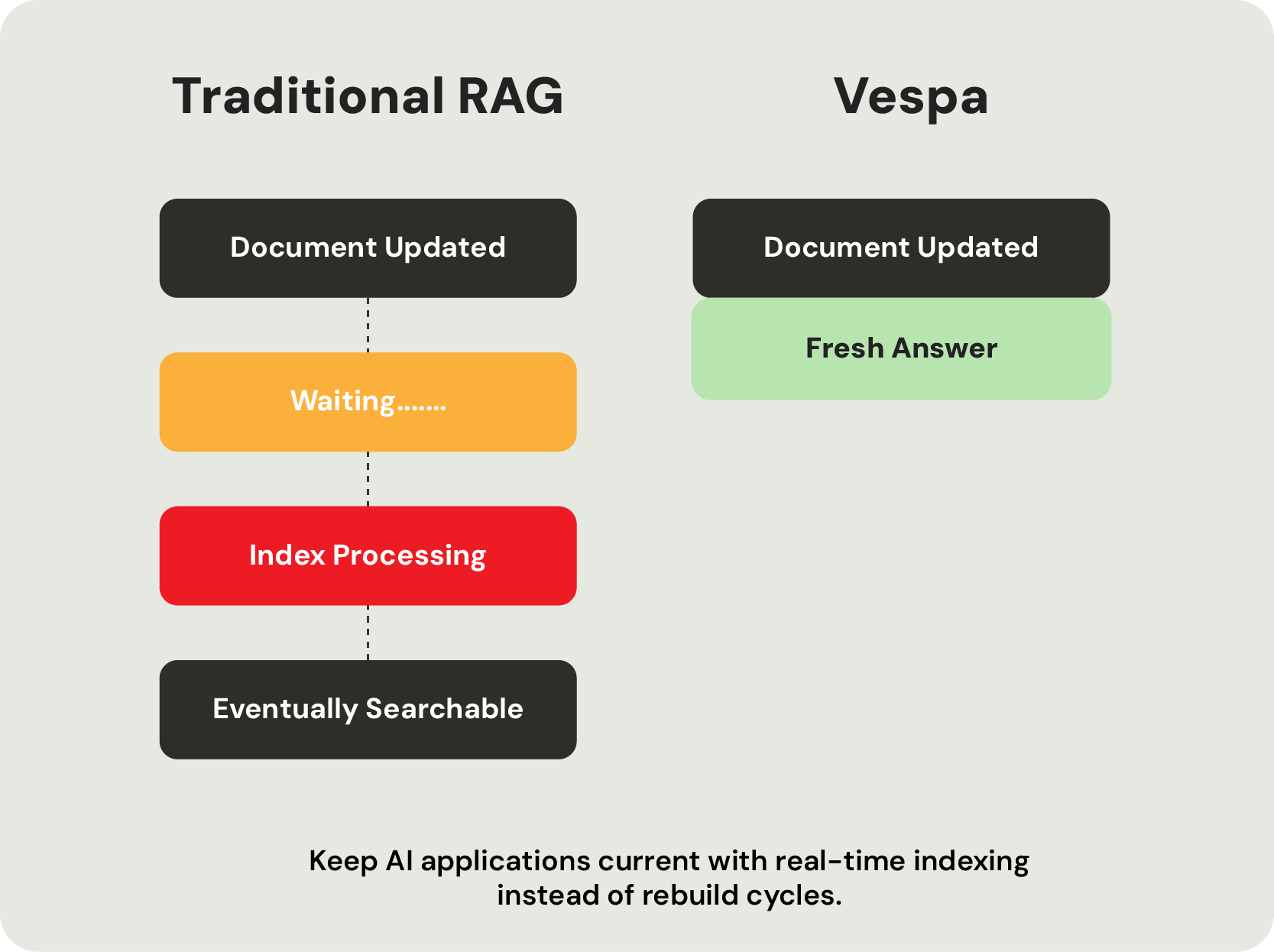
The quality of AI-generated answers depends on fresh retrieval. Documents, embeddings, user signals, and business data should become searchable immediately—not after an index rebuild or scheduled refresh. Vespa continuously indexes and updates data while serving live traffic, keeping RAG, agentic AI, search, and recommendation applications synchronized with the latest information.

High Performance at Scale

Keep AI retrieval fast as applications grow.

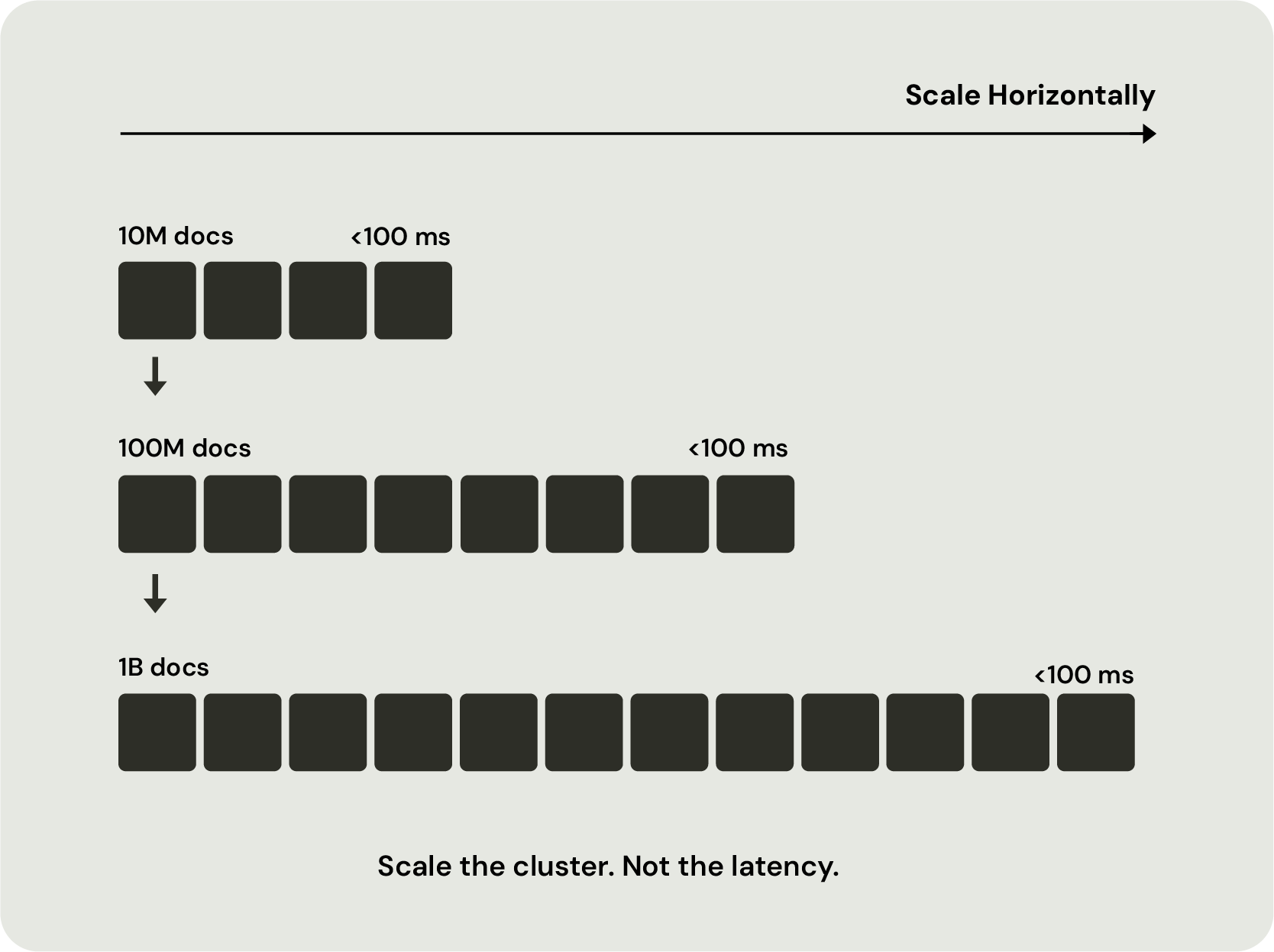
As AI workloads grow, many architectures add retrieval stages, rerankers, and inference services that increase latency and operational complexity. Vespa scales retrieval, ranking, and machine learning together in a single distributed serving engine, maintaining high throughput and predictable latency as data volumes, users, and AI agents grow.

We Make AI Work at Perplexity

Perplexity delivers millions of users accurate, cited answers by combining large language models with real-time AI retrieval. As retrieval quality becomes increasingly critical to answer quality, Perplexity relies on Vespa to retrieve, rank, and continuously update the context behind every response.

By combining hybrid retrieval, advanced ranking, machine learning inference, and real-time indexing in a single distributed serving engine, Vespa enables Perplexity to deliver fast, trustworthy answers at internet scale.

Everything Needed for AI Retrieval

  • Unified Vector, Text, and Structured Retrieval

    Vespa brings all retrieval methods into a single, cohesive engine. You can combine dense embeddings, keyword signals, and metadata filters into a single query, eliminating the need for multiple systems or external orchestration.

  • Built-in Ranking and ML Inference

    Vespa lets you deploy ranking models directly inside the serving layer using ONNX, XGBoost, or custom functions. You can perform first-phase recall with embeddings, then re-rank with machine learning models to maximize accuracy and explainability.

  • Real-Time Indexing and Updates

    Unlike immutable-segment vector systems, Vespa supports continuous data ingestion and updates without costly index rebuilds. Applications stay fresh and responsive even under high write throughput.

  • Advanced Filtering and Aggregation

    Beyond similarity search, Vespa supports structured filters, geospatial queries, and aggregations directly on vector fields. This allows you to combine semantic and business logic seamlessly.

  • Tensor-Native Architecture

    Vespa stores and computes on tensors, not just vectors. This enables multi-dimensional representations that capture relationships between modalities such as text, images, and numeric data, supporting both dense and sparse features for hybrid search.

    Explore tensors
  • Multimodal and Multi-Vector Support

    Vespa supports multiple embeddings per document, enabling use cases such as ColBERT or ColPali-style retrieval, image–text matching, and cross-modal search all within the same schema.

Build with The RAG Blueprint

The RAG Blueprint is Vespa's reference architecture for building production-ready AI retrieval applications. It brings together hybrid retrieval, multi-phase ranking, real-time indexing, and machine learning inference into a modular implementation that reflects the principles described on this page.Whether you're building a new RAG application or scaling an existing one, the Blueprint helps you move from architecture to implementation faster.

How Does Vespa Compare?

Many RAG architectures stitch together a vector database, search engine, reranker, and machine learning services to build the retrieval workflow. While this approach can improve answer quality, it also increases latency, infrastructure cost, and operational complexity as applications scale.

Vespa takes a different approach. Retrieval, ranking, filtering, machine learning inference, and real-time indexing run together in a single distributed serving engine. Instead of optimizing individual components, Vespa optimizes the entire retrieval workflow, delivering more accurate context with lower latency and a simpler architecture for large-scale AI retrieval.

Frequently asked questions

Need more than a quick answer?

If these FAQs don't answer your question, there are several ways to continue:

Learn the fundamentals with our free online training at learn.vespa.ai.

Experience Vespa yourself with a free Vespa Cloud trial.

Watch the Getting Started with Vespa AI Search YouTube video

Contact our team to discuss your application or migration project.
What is Retrieval-Augmented Generation (RAG)?
Retrieval-Augmented Generation (RAG) is an AI technique that grounds large language models (LLMs) in external data sources before generating a response. Instead of relying solely on fixed, pre-trained knowledge, a RAG system fetches relevant facts from an external knowledge base, to deliver accurate, up-to-date, and context-aware answers.
Why should I use Vespa for RAG?
Vespa was designed for production AI retrieval, combining vector search, keyword search, filtering, ranking, and machine learning inference in a single distributed serving engine. Rather than stitching together multiple retrieval systems, Vespa allows you to build RAG applications on a unified platform that delivers higher retrieval quality, lower latency, and simpler operations at scale.
Why do RAG systems hallucinate?
Hallucinations, in which an LLM outputs incorrect results, are often blamed on the language model, but many originate earlier in the retrieval pipeline. If the retrieval system provides incomplete, outdated, or irrelevant context, the LLM can only generate answers from the information it receives. Improving retrieval quality is often the most effective way to improve answer quality.
How does Vespa improve RAG quality?
Vespa improves RAG quality by combining semantic retrieval with keyword search, filtering, ranking, and machine learning inference within a single retrieval pipeline. Rather than relying on semantic similarity alone, Vespa enables multiple retrieval signals and rerankers to work together, helping AI models access more relevant, trustworthy context while simplifying the overall retrieval architecture.
Why isn't vector search enough for RAG?
Vector search finds semantically similar content, making it an important part of modern RAG. However, production RAG systems also require keyword matching, metadata filtering, freshness checks, security filtering, personalization, and business-specific ranking. Relying on semantic similarity alone often retrieves plausible but incomplete or irrelevant context. Vespa combines vector search with lexical retrieval, filtering, and advanced ranking so AI models receive higher-quality context.
Does Vespa support agentic RAG?
Yes, Vespa provides all the tools required for an AI retrieval workflow, including RAG, to support agentic AI, with results delivered via a standard API. Agentic AI often performs many retrieval operations for a single user request, making retrieval quality, latency, and scalability increasingly important. Vespa provides the retrieval, ranking, and inference capabilities needed to support these workloads through a single distributed serving engine.
Can Vespa support multi-vector retrieval?
Yes. Vespa supports multiple embeddings per document, enabling use cases such as ColBERT or ColPali-style retrieval, image–text matching, and cross-modal search all within the same schema.
How does Vespa handle real-time data in RAG?
Vespa supports continuous data ingestion and updates without costly index rebuilds. Applications stay fresh and responsive even under high write throughput. Furthermore, Vespa’s distributed architecture delivers <100 ms latency, ensuring accurate results in near real time.
Can I build GraphRAG with Vespa?
Yes. Vespa stores and retrieves structured data alongside vectors, allowing graph-like relationships, metadata, and semantic retrieval to work together without necessarily requiring a dedicated graph database for many GraphRAG workloads.
Is ranking as important as retrieval?
Retrieval identifies candidate documents. Ranking determines which of those documents are most relevant to the user or AI application. As retrieval systems grow, ranking increasingly combines semantic similarity, keyword relevance, freshness, personalization, business rules, and machine learning models. For many production AI applications, ranking has become the primary factor in retrieval quality.
Can Vespa replace both a search engine and a vector database?
Yes. Vespa combines keyword search, vector retrieval, filtering, ranking, and machine-learning inference into a single distributed engine. Many organizations use Vespa to replace multiple retrieval systems, simplifying architecture while improving performance and reducing operational complexity.
Can Vespa run machine learning models during retrieval?
Yes. Vespa executes machine learning models directly within the retrieval pipeline, including ONNX and XGBoost models as well as custom ranking functions. Running inference where retrieval occurs reduces latency and eliminates the need for separate model-serving infrastructure.
What is multimodal RAG?
Multimodal retrieval combines information from different data types such as text, images, audio, and structured data within a single search. Vespa supports multimodal retrieval through its tensor-native architecture, enabling applications to retrieve and rank across multiple modalities with a single engine.
Can Vespa connect to my existing LLM?
Yes. Vespa focuses on retrieval rather than text generation and integrates with leading LLM providers and frameworks, including OpenAI, Anthropic, Gemini, LangChain, LlamaIndex, Haystack, and custom applications through standard APIs. This allows you to combine Vespa's retrieval capabilities with the language model of your choice.
Is chunking the only way to improve RAG retrieval?
No. Chunking is one approach to fitting documents within an LLM's context window, but it introduces trade-offs around chunk size, overlap, metadata duplication, and retrieval accuracy. Vespa supports conventional chunking while also enabling advanced retrieval approaches, including multi-vector retrieval and parent-child document retrieval, allowing developers to optimize retrieval quality without relying solely on chunking strategies.

Ready to optimize retrieval workflows

Whether you're building customer-facing RAG, agentic AI, or AI search applications, we'd be happy to discuss your architecture and show how Vespa brings retrieval, ranking, and machine learning together in a single AI Search Platform designed for large-scale AI retrieval.

More resources

Explore related guides, videos, case studies, and technical documentation in our resource library to learn more about AI search and retrieval with Vespa.